
Nikro Air Duct Cleaning in Thornton: A Homeowner’s Guide
Nikro builds some of the highest-performing portable negative air machines and duct cleaning systems in the professional market, and that performance only shows up when the technician running it understands system configuration, negative pressure, and agitation sequencing. The catch is that a Thornton homeowner has no way to know whether a contractor really owns Nikro gear or just lists it on a website. This guide gives you the exact questions to ask before anyone walks through your door.
Key Takeaways
- Nikro’s portable units pull airflow that most consumer and entry-level setups simply can’t match, which matters most in ranch homes and complex return layouts.
- The equipment is only half the story: negative pressure management, filtration stages, and agitation sequencing decide whether the job actually works.
- You can verify Nikro equipment in person before the job starts. Ask, then look.
- If you’d rather not vet this yourself, call (888) 845-7534. We answer 24/7. Fast dispatch from 7am to 7pm, Sunday through Friday.
What does Nikro equipment actually do at a mechanical level?
Nikro’s core product line falls into three categories: negative air machines, HEPA vacuums, and complete duct cleaning systems. Each does a different job, and confusing them is where cheap bids fall apart.
Negative air machines. These units pull air out of the duct system and hold the whole system under suction so loosened debris travels toward the collection point instead of drifting into your living room. Nikro rates its portable units in cubic feet per minute (CFM), and the professional models move substantially more air than a shop vac ever will. High CFM isn’t a vanity number. It’s what keeps debris airborne and moving in the right direction once a rotary brush starts breaking material loose.
HEPA vacuums. Standard vacuums capture the big stuff and blow the fine particulate back out through the exhaust. HEPA filtration stages trap particles far smaller, in multiple stages, so the air leaving the machine is cleaner than the air entering it. In a Thornton home with dust-sensitive residents or a recent renovation, that difference is the whole job.
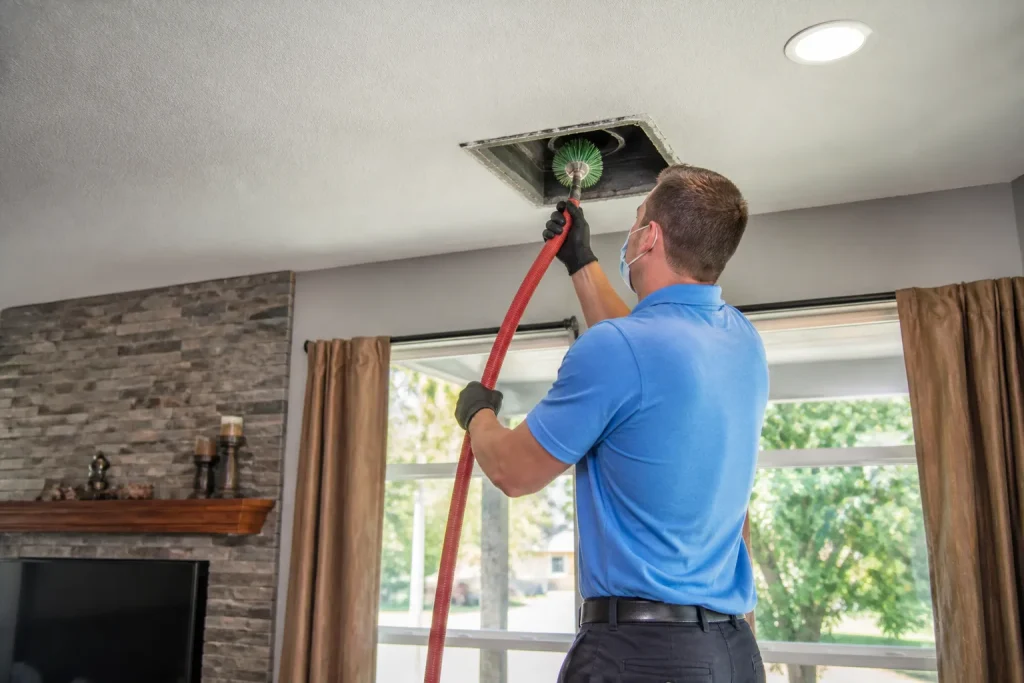
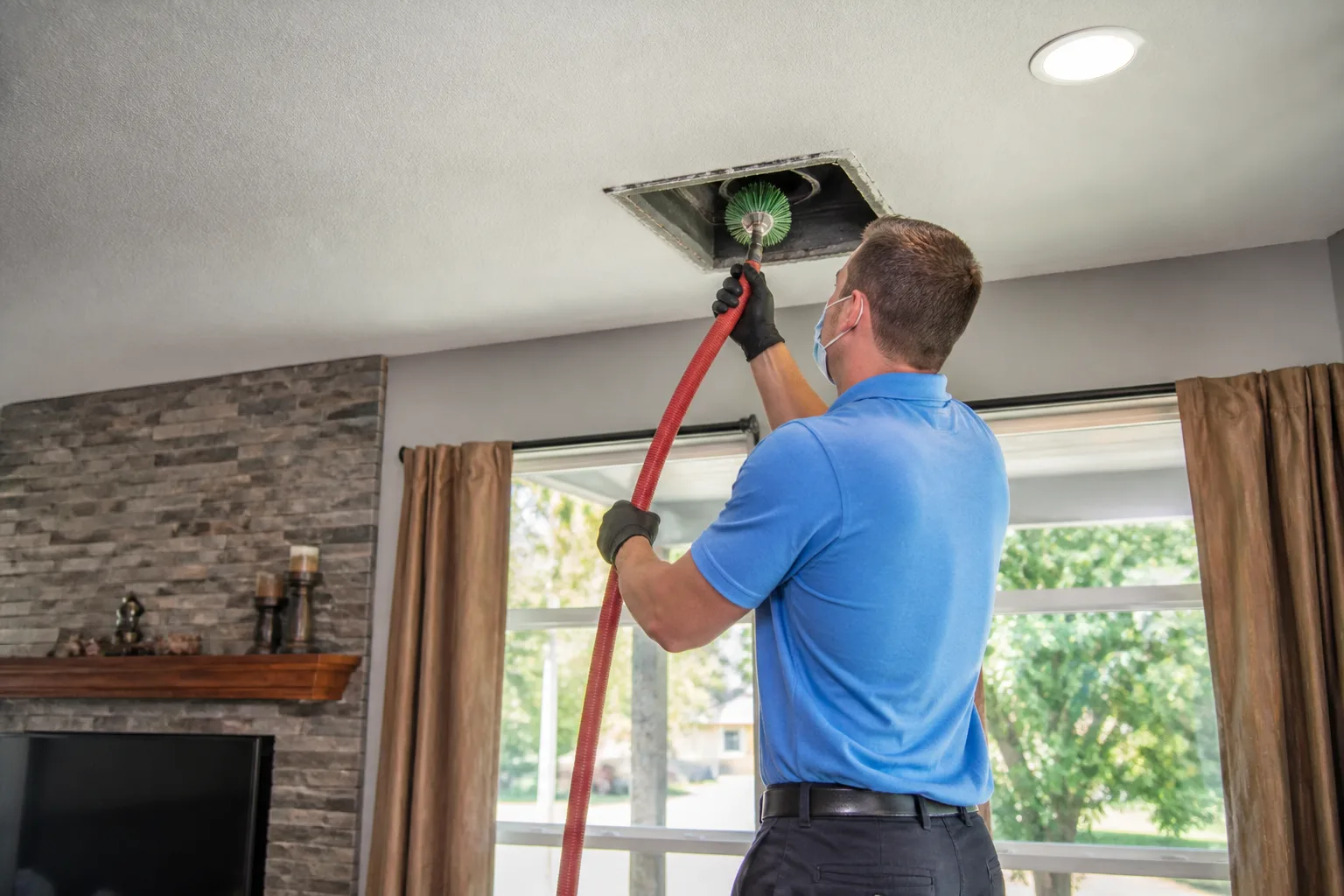
Duct cleaning systems. Nikro’s integrated systems combine the vacuum source with rotary brush agitation and hose runs designed for real residential ductwork. The brush loosens caked-on debris; the vacuum captures it. One without the other is a half-finished job.
Here’s what to ask: which Nikro model, what CFM rating, and how many filtration stages. A technician who can answer those three questions without hesitating is working with their own equipment. If the answer gets fuzzy, that tells you something too.
Why does portable Nikro equipment suit Thornton’s housing stock?
Thornton’s neighborhoods are dominated by single-story ranch homes, with a large share of two-story builds and a steady supply of older housing stock mixed in. That mix creates a practical problem: truck-mounted equipment needs a hose run from the street to the duct system, and long runs lose pressure and limit where a technician can work.
Portable Nikro units solve that directly. Instead of a single hose stretching from a truck, the machine sits inside the home near the access point, which means:
- Shorter hose runs, less pressure loss. The vacuum stays close to the work, so CFM at the register is closer to what the machine is rated for.
- Better access in tight layouts. Basement mechanical rooms, crawlspace returns, and attic-routed flex in two-story homes are all reachable without a hose run stretching across the lawn.
- Containment control. When paired with Abatement Technologies containment gear, the technician can hold negative pressure in the working zone and capture particulate at the source rather than hoping the whole house stays clean.
In our experience across Thornton, the homes that get the worst value from a cheap clean are the ones with long runs or complex return configurations. A portable, high-CFM machine near the source is the difference between vacuuming the first few feet of ductwork and actually cleaning the system.
Which duct cleaning jobs call for Nikro-grade equipment?
Entry-level equipment can handle light maintenance dust on a simple system. It struggles with three specific job types, and those are exactly the jobs where homeowners notice the results.
- Post-renovation debris loads. Drywall dust, sawdust, and construction grit settle through the entire system after a kitchen or basement remodel. The volume is high, the particles are fine, and the load is heavy. High-CFM suction plus multi-stage HEPA filtration keeps it in the machine instead of the breathing zone. A lower-spec unit will pull some of it and redistribute the rest.
- Flex duct systems. Flex duct is ribbed on the inside, which traps debris in every ridge. Rotary brush agitation has to be gentle enough not to damage the liner and thorough enough to actually break it loose. That’s a technique question as much as an equipment question, and it’s why contractor-grade rotary systems exist in the first place.
- Complex return configurations. Homes with multiple return trunks, jump ducts, or zoned systems require the technician to sequence which branch is under suction while the others stay isolated. Get the sequencing wrong and you pull debris from the dirty branch into a clean one. Nikro-style portable units with proper branch isolation are what make that possible.
If your Thornton home fits any of these, ask specifically what equipment will be on site and how the technician plans to sequence the job. That question alone filters out a lot of noise.
How do you verify Nikro equipment is actually being used in your home?
Equipment gets listed on websites. Equipment that shows up in your home is another matter. The verification doesn’t require any technical knowledge: it requires asking, then looking.
Before the job is booked, ask:
- What machine will be on site, and can you tell me the CFM rating?
- How many filtration stages does it have, and is HEPA part of the setup?
- Do you bring containment equipment for the working area?
- Will the vacuum source be inside the home or truck-mounted with a long hose run?
When the technician arrives, look for:
- A machine with a manufacturer plate you can read. Nikro units are labeled, and the model number is visible.
- A filtration stack or HEPA housing on the exhaust side. If there’s no filter housing, there’s no HEPA.
- Containment materials around the working zone, not just a drop cloth.
- Separation between the dirty work area and your living space, even a simple barrier.
If the equipment that arrives is a shop-vac and a long hose, that’s your answer, and it’s fair to stop the job there. A professional working with serious gear won’t be bothered by the questions. A contractor substituting lower-spec machines will be, and knowing that before work starts is worth more than any coupon.
What does a Nikro-equipped clean look like from the homeowner’s side?
You don’t need to understand the mechanics to know when a job is being done properly. Here’s what a typical Nikro-equipped clean looks like from the moment the machine comes through the door.
Setup takes real time. Fifteen to thirty minutes is normal for a properly configured job: laying containment, locating the machine, connecting hose runs, and setting up branch isolation. Fast setup usually means shortcuts. If the technician is running the brush within five minutes of arrival, ask why.
The machine sounds like it means it. A Nikro negative air unit under load has a deep, steady, continuous tone. It pulls hard and stays loud. What you should not hear is the pitch changing constantly, which often means the system is losing pressure because a branch is open when it shouldn’t be.
The technician monitors during the negative pressure phase. A properly trained operator checks that pressure holds steady across the system, watches for branches that aren’t pulling, and adjusts isolation as needed. This is where experience shows. Our technicians have up to 11 years of experience, and the difference between a trained operator and an untrained one is exactly this kind of attention during the suction phase.
Air quality systems get protected. Homes with Honeywell or Aprilaire components need those systems respected during the clean. Familiarity with those products means the technician cleans around them without risking damage or voiding anything.
You get before-and-after photos of your own ducts. Not stock images. Your system, documented. Ask for them before work starts so there’s no awkward conversation later.
When to call a pro
If you’re seeing dust blowing from registers right after a renovation, noticing a musty smell that comes back within days of a cheap clean, or hearing the HVAC system struggle to pull return air from certain rooms, that points to a system-level issue that a quick vacuum pass won’t fix. Duct repair and sealing is often needed alongside cleaning, and sanitizing may be warranted if there’s microbial growth or persistent odor. If you don’t want to run the verification questions yourself, call (888) 845-7534 and we’ll walk you through what your system likely needs.
Related services in Thornton
If you’re evaluating equipment and process, it’s worth understanding the full scope. Learn more about air duct cleaning in Thornton, dryer vent cleaning as a separate fire-safety service, and HVAC cleaning for the components upstream of your ducts. For a full look at our approach, see Thornton Air Duct Cleaning Pros.
The Bottom Line
Nikro equipment is worth asking about because it tells you something about the contractor behind it. High CFM and multi-stage HEPA filtration only produce the clean they’re capable of when the technician running the gear understands negative pressure, branch sequencing, and proper agitation. In a Thornton housing stock built around ranch homes and two-story layouts that make truck-mount runs awkward, the portable Nikro approach is often the practical answer, and the questions in this guide will help you confirm it’s really being used.
You don’t have to become an equipment expert to get a straight answer. Ask about the model, the CFM, and the filtration stages. Sort out the presence of containment gear and in-home vs. truck-mounted placement. Everything else follows from those answers. A clear process, one flat price per system agreed before work starts, before-and-after photos of your own ducts, and a satisfaction guarantee are what to hold out for. If a company hesitates on any of that, walk away.
If you’re in Thornton and need help, Thornton Air Duct Cleaning Pros offers free estimates. Call (888) 845-7534. We answer 24/7. Fast dispatch from 7am to 7pm, Sunday through Friday. Estimates are free, and the written estimate sets the final price.
Frequently Asked Questions
Typical whole-system estimates in the Thornton area run based on system size, number of vents, and job complexity, and the written estimate you receive sets the final price. We don’t quote per-vent prices or teaser figures, because those numbers rarely match what shows up on the invoice. Call (888) 845-7534 for an exact quote. Estimates are free.
Cheap quotes usually reflect lower-spec equipment, shorter job time, and shortcuts on containment or filtration. If a contractor shows up with a shop-vac instead of a Nikro-grade negative air unit with HEPA filtration, the price difference is the equipment. Ask what machine will be on site before booking. If the numbers look too good, call (888) 845-7534 and we’ll help you compare apples to apples.
You get before-and-after photos of your own ducts, not stock images, and you’re present for the setup and negative pressure phase. A properly equipped job is visible: the machine, the containment, the hose runs, and the time spent on setup all show. Ask for photos as part of the job from the start. Call (888) 845-7534 to talk through what a verifiable clean looks like for your home.
Most Thornton homes benefit from a full clean every few years, and more often after a renovation, a move-in, or if anyone in the household has respiratory sensitivity. There’s no fixed rule, because duct condition depends on the home. If you’re unsure, call (888) 845-7534. Estimates are free, and we’ll tell you honestly if your system doesn’t need it yet.
Written by the team at Thornton Air Duct Cleaning Pros.
Need Air Duct Cleaning Help?
Call Thornton Air Duct Cleaning Pros - the local pro we connect you with is licensed and insured, with free written estimates in Thornton.
(888) 845-7534